Your Sun sign is one piece of a much larger pattern. A natal chart contains the Moon, planets, twelve houses, and the angular relationships between them. A thoughtful reading synthesizes those layers instead of listing disconnected traits.
What is a birth chart?
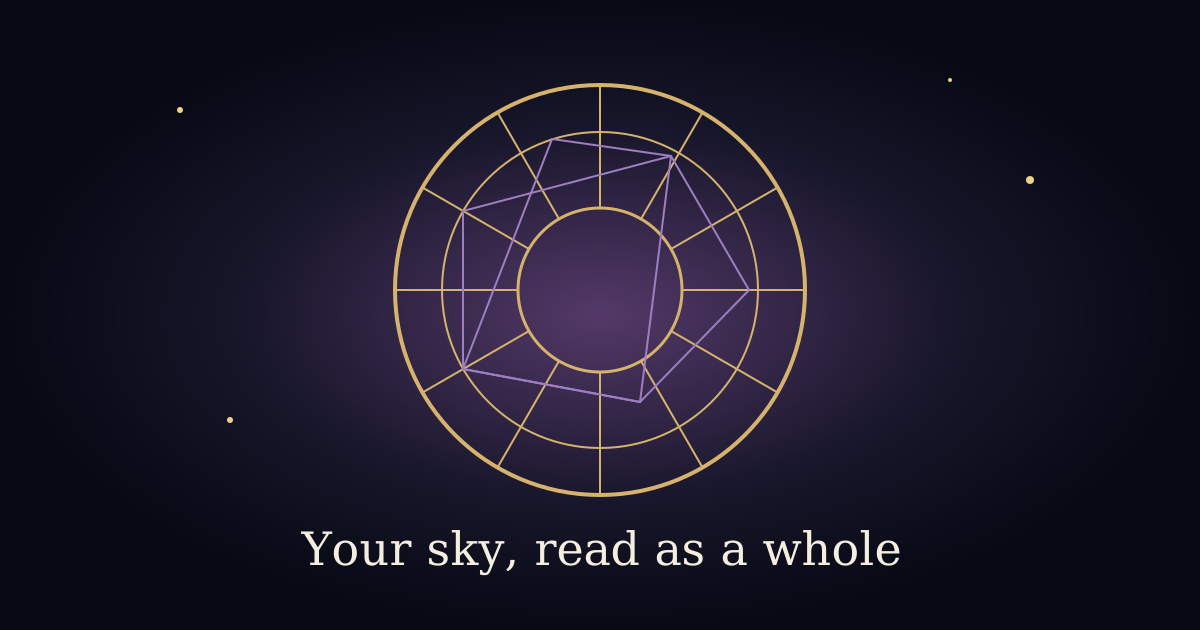
A birth chart, or natal chart, is a circular map calculated for a particular moment and location. The outer ring contains zodiac signs, the inner divisions show houses, and symbols mark planetary positions. Lines through the center often represent aspects, the measured angles between planets.
Astrology is a symbolic tradition rather than a scientifically validated predictor of personality or events. Its value for many people is reflective: it supplies language for patterns, contradictions, needs, and choices.
The birth details you need
- Birth date establishes the day's planetary positions.
- Exact birth time calculates the rising sign and houses, which change through the day.
- Birthplace anchors the chart to the correct horizon and time zone.
Use a birth certificate or reliable family record when possible. If the time is unknown, do not guess and present the result as certain. You can still discuss many planetary signs and aspects, but the rising sign, houses, and sometimes the Moon may be uncertain.
Start with your Big Three
- Sun: vitality, identity, purpose, and the qualities you are learning to embody.
- Moon: emotional rhythms, instinctive needs, safety, and private responses.
- Rising sign: your chart's eastern horizon, which shapes first approach and sets the house structure.
The Big Three may agree or pull in different directions. That tension is not a flaw. A reserved rising sign, expressive Sun, and security-seeking Moon can describe different needs activated in different contexts.
What the planets represent
- Mercury: thinking, learning, and communication.
- Venus: relating, attraction, taste, and values.
- Mars: action, desire, anger, and assertion.
- Jupiter: growth, meaning, confidence, and excess.
- Saturn: limits, responsibility, endurance, and mastery.
- Uranus, Neptune, and Pluto: slower collective themes that become personal through houses and aspects.
A planet never operates only through its generic keyword. Mercury in a sign describes a communication style; its house locates where that style is emphasized; its aspects show which other drives support or complicate it.
What the twelve houses represent
The houses describe areas of experience: identity, resources, communication, home, creativity, routines, partnership, shared resources, belief, public life, community, and retreat. A house is not a prediction that something will happen there. It is a field where particular planetary themes may become more noticeable.
The first, fourth, seventh, and tenth houses are angular and often receive special attention because they relate to self, roots, partnership, and public direction.
How aspects connect the chart
Aspects are geometric relationships between planets. Conjunctions merge energies; oppositions create polarity; squares generate friction and action; trines suggest ease; sextiles suggest supportive opportunities. No aspect is purely good or bad. Ease can become complacency, while tension can build skill and momentum.
How to read a birth chart step by step
- Confirm the birth data and note any uncertainty.
- Identify the Sun, Moon, rising sign, and chart ruler.
- Look for repeated elements, modalities, signs, or houses.
- Find planets close to the four chart angles.
- Study the tightest major aspects and any repeating pattern.
- Synthesize one theme at a time: emotion, relationships, work, or communication.
- Translate each insight into a question, experiment, or choice.
Avoid interpreting every placement with equal weight. Repetition creates emphasis. Three chart factors pointing toward independence are usually more significant than one isolated placement suggesting accommodation.
What a reading can help you explore
A natal reading can offer language for emotional needs, communication habits, relationship patterns, motivation, creative strengths, career preferences, and periods of transition. Compatibility readings compare two charts, while transit readings examine how current planetary cycles relate symbolically to the natal map.
The strongest questions remain open and usable: “What tension shapes the way I communicate under stress?” is more constructive than “Will this relationship definitely last?”
Limits and ethical boundaries
A chart cannot prove character, compatibility, fertility, illness, death, or a guaranteed future event. It should never override consent or replace medical, legal, mental health, or financial expertise. Be cautious of readers who use fear, claim unavoidable disaster, or pressure you to purchase a remedy.
You are also more than your chart. Culture, family, opportunity, health, environment, and deliberate practice shape a life in ways a symbolic map cannot contain.
Frequently asked questions
Can I read my birth chart without a birth time?
Yes, partially. Many planetary signs and aspects remain available, but the rising sign and houses cannot be established reliably.
What is the difference between a birth chart and a horoscope?
A birth chart is calculated for your birth data. A horoscope usually interprets current cycles, often for a broad Sun or rising sign audience.
How often should I get a natal chart reading?
Your natal chart does not change, so one thorough reading can remain useful for years. Return when you have a genuinely new focus rather than for repeated reassurance.
Can a birth chart predict marriage or career?
It may support reflection on relationship and work patterns, but it cannot guarantee a particular partner, profession, or date.
Final thoughts
A birth chart becomes useful through synthesis. Start with the Big Three, follow repeated themes, and connect symbolism to lived experience. The chart can be a mirror for inquiry, but you remain the person making the choices.
Related articles
Readings may be generated or enhanced using AI-guided interpretation and are designed as a spiritual and reflective experience.
For entertainment and personal reflection only. Velvet Astral readings are not medical, legal, financial, or mental health advice, and should not be used as a substitute for professional guidance.