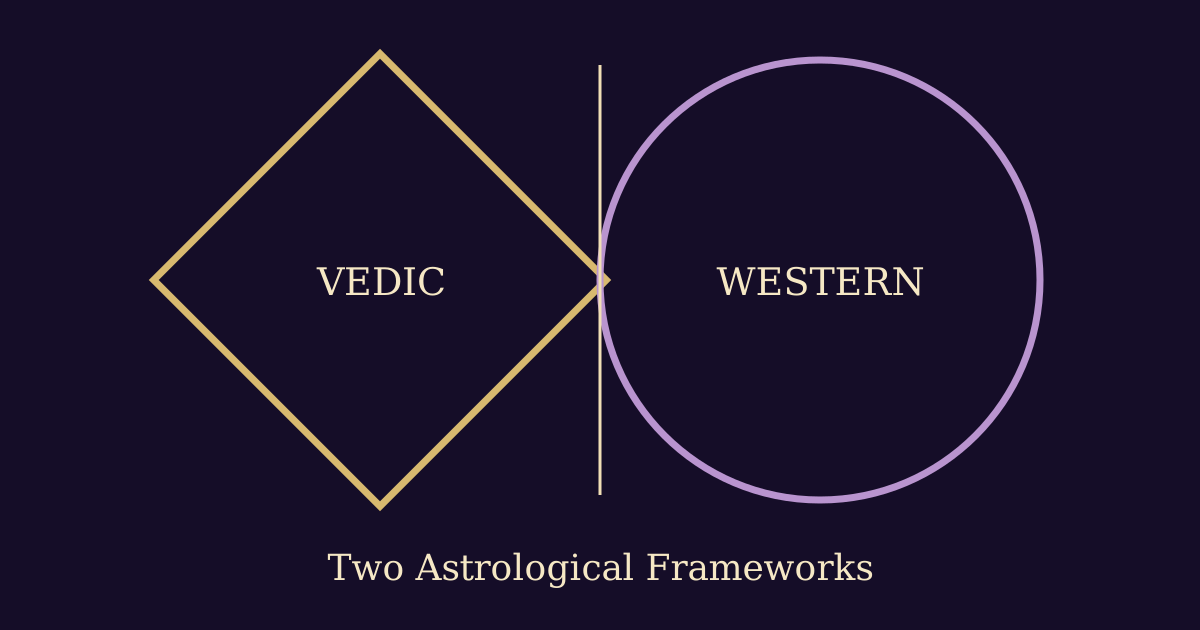
Shared Roots, Different Systems
Both traditions work with planets, zodiac signs, houses and aspects, but developed distinct philosophical languages and technical priorities. Simplifying either into stereotypes creates a poor comparison.
Sidereal vs Tropical Zodiac
The tropical zodiac anchors zero Aries to the March equinox. Sidereal systems apply an offset called Ayanamsha to relate zodiac positions to a stellar reference. Different Ayanamshas exist within sidereal practice.
Why Your Sign May Change
The current offset is roughly one sign for many placements, so a tropical planet may fall in the preceding sidereal sign. Not every placement changes, and the sign label is only one piece of either chart.
Chart Formats
Western charts are often circular. North and South Indian Jyotish formats use diamond or square layouts. The geometry displays the same twelve houses differently.
Planets and Lunar Nodes
Jyotish traditionally emphasizes seven visible planets plus Rahu and Ketu, the lunar nodes. Many Western approaches include Uranus, Neptune, Pluto and additional points.
Houses and Aspects
Whole-sign houses are common in Jyotish, though methods vary. Jyotish aspects may be planet-specific; Western practice often emphasizes angular relationships measured by degree.
Timing Techniques
Jyotish is known for Dashas alongside transits. Western astrology often uses transits, secondary progressions, solar returns and other techniques.
Nakshatras
The 27 lunar mansions are a distinctive Jyotish layer used for symbolism, timing and traditional compatibility.
Which System Should You Use?
Choose the system whose methods you want to study consistently. Do not mix placements casually or use whichever chart produces the preferred answer.
Frequently Asked Questions
Is Vedic astrology more accurate?
Accuracy claims depend on expectations, technique and interpretation; neither system has established scientific predictive certainty.
Why are my signs different?
The tropical and sidereal zodiacs use different reference points.
Can I use both systems?
Yes, if you understand each on its own terms before comparing.
Is Jyotish only Sun-sign astrology?
No. Lagna, Moon, houses, Nakshatras and timing systems are central.
Final Thoughts
The useful question is not which tradition wins, but whether its internal method is applied carefully, transparently and without turning symbolism into certainty.
Related articles
Readings may be generated or enhanced using AI-guided interpretation and are designed as a spiritual and reflective experience.
For entertainment and personal reflection only. Velvet Astral readings are not medical, legal, financial, or mental health advice, and should not be used as a substitute for professional guidance.